
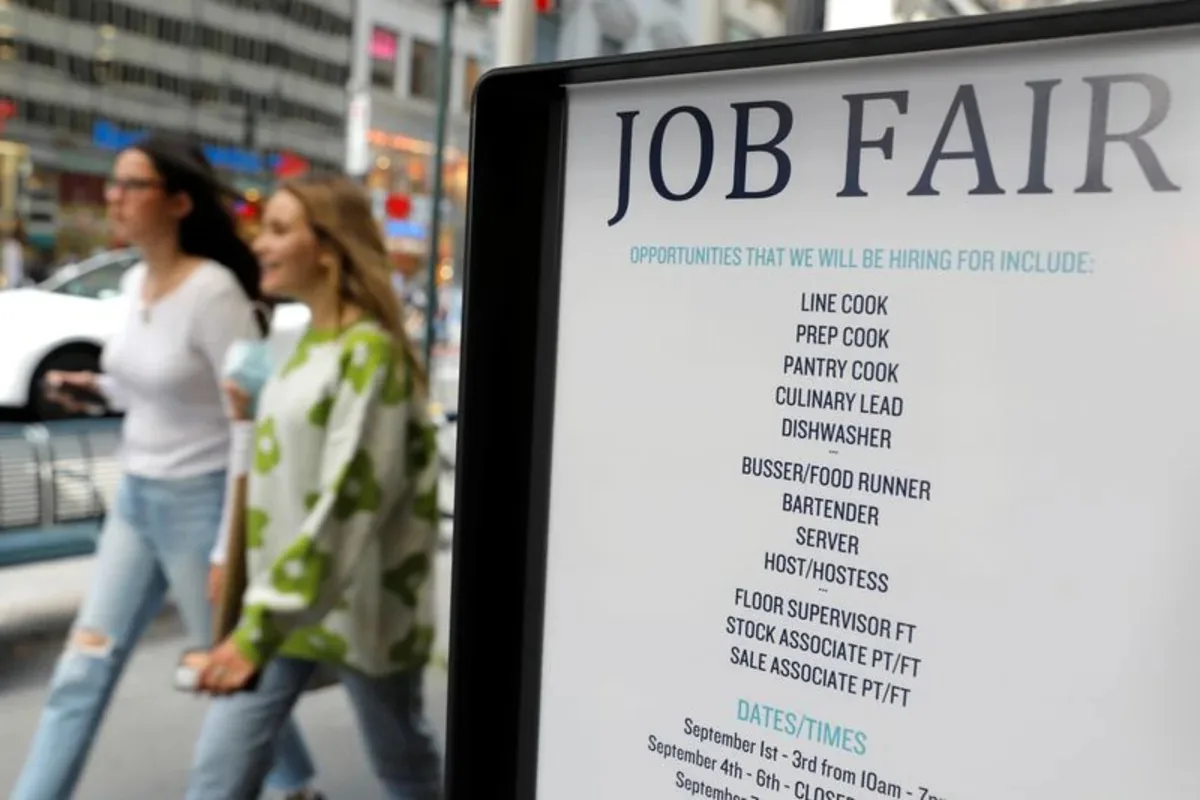
WASHINGTON, DC — U.S. job openings climbed to their highest level in two years in May, yet the broader labor picture remained mixed as hiring softened and consumers became less confident about finding work. The Labor Department said vacancies edged up to 7.594 million, the most since May 2024, while the hiring pace fell for a second straight month.
The numbers suggested a labor market that is still holding up, but no longer running hot. Economists said the data did not show meaningful damage from the U.S.-Israeli war with Iran, and many said the fragile ceasefire had reduced that risk. That, in turn, leaves the Federal Reserve with more room to focus on inflation.
Vacancies climbed, but the response rate drew caution
The Job Openings and Labor Turnover Survey, known as JOLTS, showed employers added 9,000 openings in May. That put the number of available jobs at 7.594 million, above the 7.30 million economists surveyed by Reuters had expected.
Still, some economists urged caution because the survey’s response rate has fallen sharply. Samuel Tombs of Pantheon Macroeconomics said only 24% of businesses contacted by the Bureau of Labor Statistics now agree to take part, down from 35% two years ago and about 70% in the late 2010s.
He said the lower participation rate raises the chance that the monthly figures could be distorted by nonresponse bias. The BLS data also showed there were 1.04 job openings for every unemployed person in May, little changed from April but slightly above the ratio a year earlier.
Hiring slowed even as payroll gains stayed solid
Hiring fell by 45,000 in May to 5.170 million, even though the unemployment report for the month had already shown strong payroll gains. The hiring rate held at 3.3%, but the drop reinforced the view that the labor market may be cooling in some areas.
Transportation, warehousing and utilities accounted for the largest decline in hiring, with notable decreases also seen in construction and wholesale trade. That weakness stood in contrast to a recent run of solid nonfarm payroll growth that has lasted three months.
Veronica Clark of Citigroup said the mismatch between weak hiring in JOLTS and stronger payroll growth could point to downward revisions in future data. She also said the figures might reflect weaker net job growth in the second half of May, which could spill into softer June employment.
Consumer confidence in the labor market slipped in June
A separate Conference Board survey released Tuesday showed consumers were feeling less optimistic about jobs. The share of respondents who said jobs were “hard to get” rose to 22.5% in June from 19.8% in May, the highest reading since January 2021.
At the same time, the share saying jobs were “plentiful” was nearly unchanged at 24.9%. The survey’s labor market differential narrowed to 2.4 from 5 in May, a measure that has tracked closely with the unemployment rate in the Labor Department’s jobs report.
Dana Peterson, the Conference Board’s chief economist, said consumers expect little change in the labor market over the next six months. That softer outlook helped offset some of the broader confidence gains tied to lower gasoline prices.
Industry trends showed strength in restaurants and trade
The May openings data were uneven across industries and business sizes. Most vacancies were at firms with 10 to 249 employees, while companies with fewer than 10 workers reported 132,000 fewer openings.
Leisure and hospitality added 95,000 vacancies, with most of those openings in restaurants and bars. Wholesale trade posted 71,000 additional unfilled jobs, and openings also rose in construction and manufacturing.
But other major sectors weakened. Healthcare and social assistance, one of the main drivers of job growth, saw vacancies fall by 115,000. Finance and insurance lost 69,000 openings, and transportation, warehousing and utilities had 43,000 fewer unfilled positions.
Layoffs stayed low and quits suggested less confidence
The same report showed layoffs increased by 41,000 to 1.708 million in May, but that level remained low by historical standards. Layoffs rose in construction, retail and healthcare and social assistance, while they fell in arts, entertainment and recreation and in professional and business services.
The layoffs rate ticked up to 1.1% from 1.0% in April. Resignations also rose only modestly, increasing by 22,000 to 3.065 million, and the quits rate stayed at 1.9%.
Economists view quits as a sign of worker confidence, since people usually leave jobs when they believe a better one is available. Sneha Puri of Indeed Hiring Lab said the latest data suggest many workers do not see that kind of opportunity right now, while also indicating wage inflation is not a current threat.
Fed policy, June jobs data and markets point to a cautious summer
The mixed data arrive just before the June employment report, due Thursday, which economists surveyed by Reuters expect will show 110,000 jobs added after May’s increase of 172,000. The unemployment rate is forecast to hold at 4.3% for a fourth straight month, though some analysts said it could edge higher if labor market sentiment keeps slipping.
Markets are also watching the Federal Reserve, which left its benchmark overnight rate in the 3.50% to 3.75% range this month. Policymakers’ latest projections showed they expect to raise borrowing costs later this year as they continue to battle inflation.
Wall Street reacted positively on Tuesday, with stocks rising, the dollar strengthening and Treasury yields moving higher. Analysts said the combination of steady labor demand, softer hiring and cautious consumers leaves the economy in a watch-and-wait phase heading into the next round of jobs data.